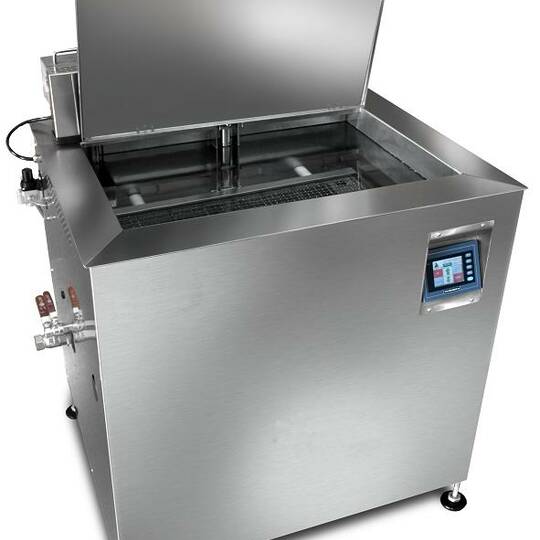
Product Overview
Ultrasonic cleaning uses high-frequency waves (starting from 20 kHz) generated in a liquid to displace and detach contaminants adhered to parts and components. The ultrasonic energy creates physical forces that break mechanical and ionic bonds of very small particles, achieving deep cleaning even in complex geometries (holes, cavities, threads, and hard-to-reach surfaces).
Key Features and Capabilities:
- Ultrasonic operation starting at 20 kHz, adaptable according to application.
- Industrial equipment in standard sizes (from 50 to 3,500 liters) and custom solutions.
- Multi-stage systems available (2, 3 or more tanks) to integrate process stages: cleaning, rinsing, drying, passivation, degreasing, etc.
- Design oriented towards industrial processes: optimization according to industry, type of dirt, materials, and cleaning requirements.
- Technical advice to select the configuration, detergents, and optimal parameters according to each use case.
Advantages for Companies:
- Increased efficiency and repeatability in industrial cleaning processes.
- Reduction of time and manual handling in degreasing and descaling tasks.
- Improvement in the quality and reliability of critical parts for sectors such as automotive, aerospace, electronics, metallurgy, medical, and general industrial use.
- Integration possibility into production lines through multi-stage equipment and custom designs.
Typical Applications:
- Cleaning and degreasing of metallic and polymeric parts.
- Surface preparation before treatments (passivation, coatings, welding).
- Industrial maintenance and restoration of components.
To define the most suitable solution, a case study is conducted (industry, type of part, contamination, volume, and production pace), and the tank configuration, ultrasonic power, and necessary stages are offered.
For more information and technical specifications adapted to your application, request technical advice and a customized quote.
Product Details
- Country of origin
- Spain
- Industrial sector
- Machinery and equipment
- Estimated HS Code
- HS 847989: Other machines and mechanical appliances - Other
Supplier

- Company
- ABRASIVOS Y MAQUINARIA, S.A.
- Address
-
Barcelona Barcelona
Spain - Telephone
- Available


