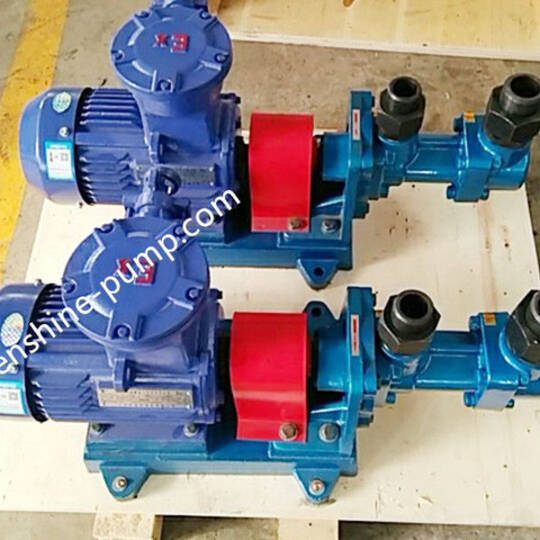
Product Overview
A robust self-priming triple-screw (three-spindle) positive-displacement pump designed for reliable transfer of fuel oil and similar non-corrosive lubricating oils. The pump uses one driven screw and two hydraulically driven idler screws that mesh with the pump insert to form a series of sealed chambers. As these chambers progress from inlet to outlet they move liquid axially and deliver a continuous, low-pulsation, constant flow under pressure.
Key features and benefits
- Positive-displacement rotary design: provides steady axial flow with minimal pressure pulsation and low noise.
- Self-priming with high suction capability: suitable for suction lift applications where priming is required.
- Long service life: idler screws are hydraulically driven and operate with an oil film between mating parts, reducing mechanical friction and wear.
- Low starting torque and vibration: moving parts have low inertia, improving start/stop behavior and reducing stress on drivers and piping.
- Safety provisions: pumps sized above the mid flow range are fitted with safety valves to protect the pump, driver and piping; excess pressured oil can be returned to the suction chamber.
- Flexible installation: available in horizontal or vertical layouts for marine installations; can be driven by AC or DC motors.
Applications
- Transfer and handling of fuel oil, lubricating oils and other non-corrosive oils (no solid particles).
- Marine fuel and oil transfer systems (marine-design 3GC variant).
Performance ranges (standard capabilities)
- Flow range: 0.2 to 590 m3/h
- Maximum working pressure: up to 100 bar
- Maximum liquid temperature: up to 150 °C
Configuration notes
- Available in general design (3G), marine design (3GC) and special-design variants to suit specific applications.
- For smaller flow models (approx. 0.2 to 6.5 m3/h) the casing and insert may be manufactured as a single part; mechanical seals are used on the shaft.
If you need dimensional drawings, material options, seal choices, or electrical drive specifications for a particular duty point (flow, pressure, viscosity and temperature), request the model and operating conditions so the correct configuration can be recommended.
Product Details
- Brand
- kenshine-pump
- Country of origin
- China
- Industrial sector
- Machinery and equipment
- SKU
- SET
- GTIN/EAN
- 841360
- MPN
- 3GC
- Model
- 3GC25*4
- Unit type
- Set
- Minimum order (MOQ)
- 1
- Estimated HS Code
- HS 841360: Other rotary positive displacement pumps
Supplier

- Company
- Kenshine Pump Mfg Co. , Ltd
- Address
-
Yindu Road 1535,Minhang District,Shanghai,China
Minhang Qu
Shanghai Shi, 215600
China - Telephone
- Available


